Showing posts with label Prost. Show all posts
Tuesday, February 19, 2013
Skifahren in der Schweiz
People at Harvard are always saying that the connections you make there last a lifetime. Unfortunately, there aren't a lot of Harvard students in my little corner of the deutschsprachigen Raum, so I haven't been able to extend the Harvard bubble for another year here. Which makes me even more happy that I made friends with the VUSers (Visiting Undergraduate Students), who are mostly Germans attending the University of St. Gallen in der Schweiz, during my last year of college. I already went to Oktoberfest with some of them, and this weekend, I was invited to a tiny village in Switzerland for skiing, sledding, eating, and other winter activities.
Location:
Braunwald, Glarus Süd, Schweiz
Saturday, February 2, 2013
A Tale of Two Bälle
Last night, I went to the TU-Ball in the Hofburg. I don't want to wax too poetic about it; I primarily want you to look at these pictures, tell me I looked stunning in my dress, and be jealous that my life is basically a fairy tale / something out of a Jane Austen novel:
![]() |
Labels:
festivals,
Fulbright,
Nazi zombies,
Prost
Location:
Hofburg zu Wien, 1010 Wien, Österreich
Sunday, January 20, 2013
Thursday, November 29, 2012
Learning German: Daham
I've been in Vienna for just short of three months now, and I've reached a point in my adjustment where I can say that nowhere in the world feels as much like home right now as this city does.
German differentiates between "die Heimat" ("home," as in the place where you're from) and "daheim" / "daham" ("home," as in where you live). I will always have a special connection to Pittsburgh -- in my complete admiration for working-class culture, in the way a turn-of-the-century brick factory brings tears to my eyes, in the way I value grit more than anything, in my complete and utter belief thats unions are the way to a better life. (Speaking of which, check this out!) Pittsburgh is and will always be a part of who I am.
But, at least for now, I'm a Wienerin, too. I have built a life for myself here.
Monday, November 19, 2012
Nur Du Allein
I realize that many of my blog posts lately have been quite snarky. Because I'm so familiar with Wien now, I don't feel the need to gush over it the way I once did. I prefer to write about the things I find amusing, the things that strike me as odd as I go about the city interacting with its people.
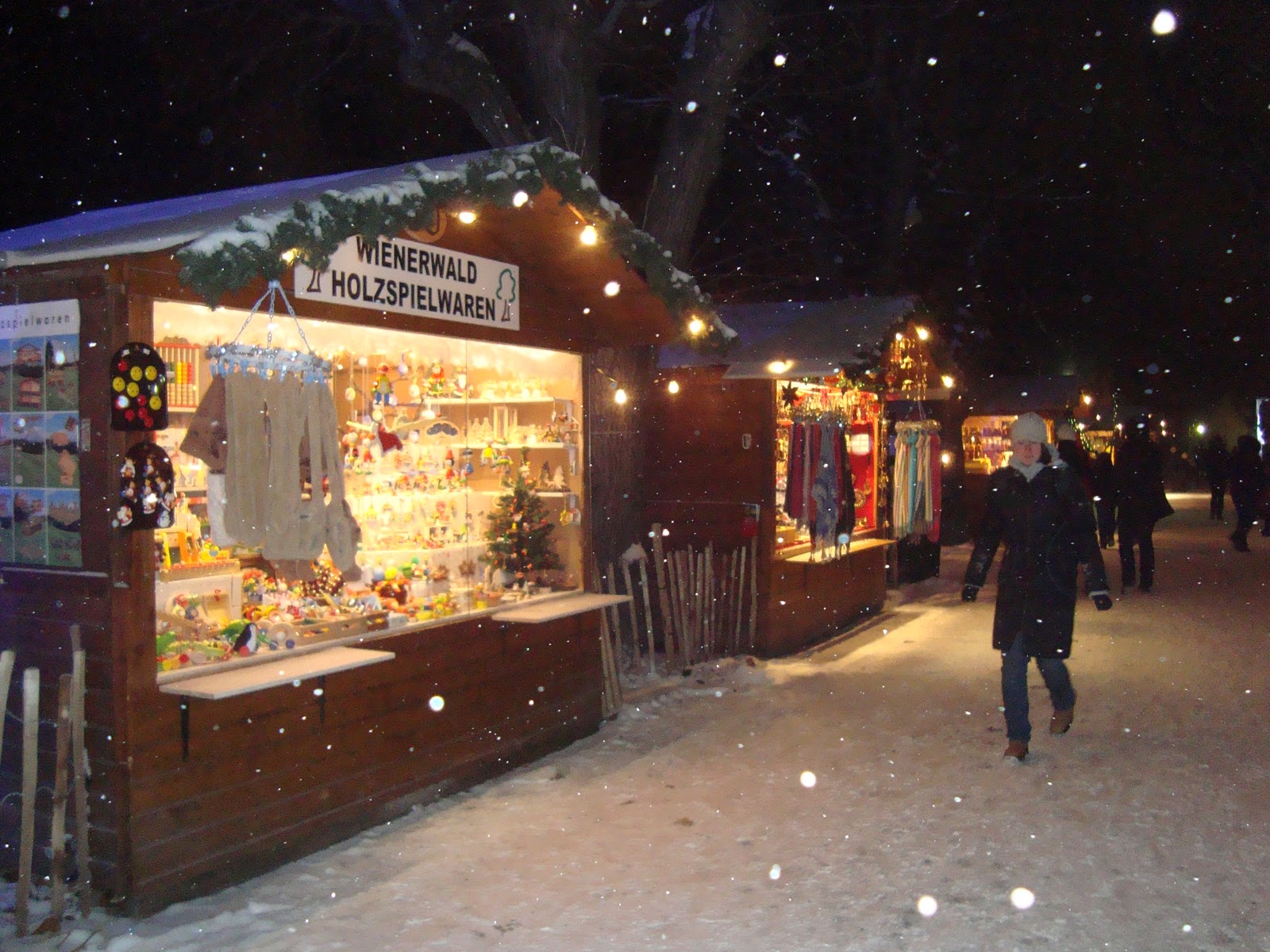
Sometimes, though, even this hardened Wienerin is struck by how lucky I am to live in such a magical city. Like this weekend, when the first Christkindlmärkte opened.
Thursday, October 4, 2012
Oktoberfest: The German Version
There are certain words that come to mind
when you think of Oktoberfest: Gemütlich. Feuchtfröhlich. Prost. There are other words, though, equally
German, that you do not think of when you think of Oktoberfest: Effizient. Durchgeplant.
Anstrengend.
Somehow, even though everyone knows that Germans love to sing cheesy yet awesome Schlager songs (click the links!) and drink beer for hours on end, and everyone knows that Germans are rigid, efficient beings who lead a society best described as "well-managed," I had never really thought about how those stereotypes conflict.
Or rather, how they mix with one another.
Because while Oktoberfest might indeed be a sloppy, happy mess of singing, beer
drinking, and Dirndl wearing, it is also an exercise in regulated consumption,
of finding the perfect balance of Hendl, Brezn, and Wurst that will allow you
to keep drinking for an entire day. It is Germany, in both the ways I expected
and the ways that surprised me.
Labels:
friends,
music,
Prost,
travel,
typisch Deutsch
Location:
Theresienwiese, München, Deutschland
Sunday, September 9, 2012
First (Third?) Impressions
Like every child of the 1990s, I love Harry Potter. But several things about the books have always bothered me: (1) If Europe's Christians decided to make witches and wizards their bitter enemies for several hundred years, why does the (witchcraft and) wizarding world still celebrate Christmas? (2) Are Muggle-born children really ready to give up their entire culture at age 11 and never look back? (3) Dumbledore's explanation aside, isn't it immoral to not share the "technological" advances of wizards with the rest of the world? It's this last one that irks me the most, though. Not because 100 million people died from the Spanish flu, which a quick spell could have healed, but because every time I travel, I think to myself, "Damn, I really wish I could apparate."
Thursday, July 14, 2011
Prater in Pictures
On Monday, the student assistants at my work took what is quickly becoming an annual trip to Prater, an amusement park in Wien, to celebrate the end of the semester. We rode the amusement park rides -- which were pretty comparable to Kennywood, with the exception of a distinct lack of large roller coasters -- and then ate dinner at Schweizerhaus, a restaurant in Prater known for its Stelze.
Location:
Prater, 1020 Wien, Österreich
Friday, July 8, 2011
Dreams Do Come True
Tracht -- traditional costumes (think Dirndls, Lederhosen, and the funny hats you wear while yodeling) --- is a huge point of social division in Austria. As my work colleague Marlene explained to me, "You either wear a Dirndl all the time, or you've never worn one."
And there are indeed people who wear Tracht just because they feel like it. My favorite example of this was at Donauinselfest, where I saw a teenager wearing a Slipknot t-shirt and a Lederhose. I just cannot fathom what went through his mind as he ruffled through his closet that morning: "Ok, so I'm going to a concert. I'll wear my heavy metal T-shirt, of course, but what should I wear on the bottom? Oh, right, my Lederhose! Great idea!" But such thoughts occur in the minds of Austrians more commonly than one would think, and I find that simply hilarious.
When I realized that Tracht has not disappeared from everyday life in Austria, it became my secret dream to see someone I knew in the traditional costume. My hopes were not very high: Sometimes a friend of mine from the dorm would come back from a weekend in their village with tagged photos of them on Facebook at some Dorffest in a Dirndl or Lederhose. But someone I knew, in Tracht, in the flesh? As my work colleague Andreas told me, "Wrong Bundesland." Tracht is conservative, traditional, rural -- everything Austrians are trying to avoid when they come to study in the Big City.
Wednesday, July 6, 2011
Bei ana Grüllarei san olle Leit dabei*
After Christmas, when the Christkindlmärkte packed up their wooden stands and disappeared from the city, I never thought I would find an Austrian activity to rival the Punschstände. But lo and behold, I just needed to wait a few months for the warmer weather, and with it, the beginning of grill season.
Monday, January 17, 2011
I Do, Indeed, Finally Fit In
In the middle of November, I wrote a blog post which unfortunately was lost to the depths of the Web when my Internet connection went dead. In it, I remember opining that I would probably first feel totally at home in Austria at my goodbye party, when I would realize that I actually was a valued member of Haus Salzburg for the short time I was there. I'm not quite ready to take my leave yet, but it is true that I both feel totally at home here and finally feel like the Austrians I know see me as someone who belongs here. A few vignettes from the weekend will show you what I mean.
Wednesday, December 15, 2010
Christmas in Wien
Winter in Wien would be almost unbearable without Christkindlmärkte. The little wooden stands seemed to sprout up on every sidewalk, Hof, and otherwise empty square inch of space in the city at the end of November.
| Christkindlmarkt am Alten AKH (near the Central College Office) |
Wednesday, December 8, 2010
Social Life
A few weeks ago, we had a midterm discussion as part of the Central College required course, in which we re-evaluated the goals we had formulated for the semester at the beginning of our time in Vienna. I was quite pleased to do this: I've participated in a lot of goal-setting sessions at the beginning of projects, but without a structured space for follow-up and adjustment, the goals become little more than words on a piece of paper that's tossed in the trash at the end of the project with a sigh of "I wish I would have done more on that." It can be easy to lose track of how micro-actions are the stuff of major movements, and that goals are achieved or neglected on the basis of day-to-day decisions.
Sunday, November 7, 2010
Learning German: der Heurige
Heurigen are wine taverns directly on the property of the vineyards whose wine they serve. They exist throughout the Eastern Austrian wine-producing region, and have become a veritable institution since Kaiser Josef II permitted vintners to begin selling their own wines in 1784. Today, there are two types of Heurigen: touristy places reachable by the tour buses full of Germans who come down to sample Austrian wine, and more rustic accommodations that often require a hike up a meandering mountain path that's too steep for the tour buses to travel. On the last day of my Mom's visit, I wanted to show her one of the latter. With a recommendation from Marie, the assistant director of my program, and a printed map from Wiener Linien (Wien's equivalent of the MBTA), we were ready to go.
Wednesday, October 6, 2010
Vokabelheft
I’ve been keeping a running list of vocabulary words -- German words that I heard for the first time, but was able to figure out through context clues; German words I read or heard without any comprehension whatsoever (thankfully, this is rarer than the first type); and English words, whose German equivalents I desperately sought during conversation, only to come up empty, leading me to either gesticulate frantically or describe around it using other words. (Dropping in English is always an option, but one I try to avoid when I’m not with other Americans. It seems kind of rude to me. But maybe that’s just a projection of some internalized “you should speak my language” Americanness, and Europeans don’t actually feel that way.)
My Vokabelheft (vocabulary-notebook), as I call it, reads like a running commentary of my time here. When I’m diligent about writing down new words, I don’t need a proper journal.
Sunday, October 3, 2010
auf der Wiesn
When I was still deciding whether or not to study abroad this semester, one of my friends told me, "The highs are going to be high, and the lows are going to be low." And during a day trip to Munich with the Goethe-Institut, I experienced it all: confusion, jubilation, frustration, contentment. It was a culture-shock roller coaster, and I was happy to be on it.
| (I was also happy to be on this roller coaster, at Oktoberfest.) |
Saturday, September 11, 2010
A lazy Saturday
For lunch, my roommate Li Hon and I decided to get the Döner Kebaps we've both been craving all week. We went to Arslan's Kebap, right across the street from the Goethe-Institut. Originally Turkish, Döner is a German takeaway staple. It's lamb meat, onions, lettuce, red cabbage (see the German influence? Food culture is so fascinating), and white sauce on a thick, toasted pita. And it tastes so good!
Because it was such a nice day (first shorts day since I've arrived: 70 F and sunny), we brought homework with us and went to Schwäbisch Hall's outdoor beer garten, on a park right on the river.
My homework was to read the weekend edition of the Süddeutsche Zeitung, a well-known paper out of Munich, and use the reading strategies we've been talking about in class. Unlike my previous German classes, where it seemed like the goal was to work towards the day when you would be fluent, this class is all about strategies to survive in German culture RIGHT NOW. Concretely, that means reminding us of elementary school reading strategies like making a list of questions we hope the text will answer, recreating an outline of the text, and using context clues to figure out the meaning of new words.
As my teacher loves to say, we're the equivalent of German ten-year-olds in terms of vocabulary, and we need to accept that we're going to read and speak like ten-year-olds, because we can't go around the world with a dictionary in hand. Being told that I need to accept my limited conversational capacity, and work within it, rather than trying to use a dictionary to speak with the same high-falutin' style I do in English, was a little hard to hear. But I think it makes a lot of sense. And I love that I can just read German blog posts and newspaper articles without taking lots of time leafing through a dictionary. Reading the newspaper today was also an interesting look into German culture: immigrant incorporation (always a controversial subject), small rural beers making a comeback -- especially among young urbanites -- a la PBR, and the growing tendency to bury people in the forest instead of in a cemetery.
| Döner Kebap |
![]() |
| Li Hon with her Döner in the Biergarten |
As my teacher loves to say, we're the equivalent of German ten-year-olds in terms of vocabulary, and we need to accept that we're going to read and speak like ten-year-olds, because we can't go around the world with a dictionary in hand. Being told that I need to accept my limited conversational capacity, and work within it, rather than trying to use a dictionary to speak with the same high-falutin' style I do in English, was a little hard to hear. But I think it makes a lot of sense. And I love that I can just read German blog posts and newspaper articles without taking lots of time leafing through a dictionary. Reading the newspaper today was also an interesting look into German culture: immigrant incorporation (always a controversial subject), small rural beers making a comeback -- especially among young urbanites -- a la PBR, and the growing tendency to bury people in the forest instead of in a cemetery.
![]() |
| Locally brewed beer and the Süddeutsche Zeitung. The perfect way to spend an afternoon. |
False Cognates
If you've ever learned a new language, false cognates -- words that sound similar in two languages but mean different things -- can be tricky. I still sometimes get tripped up by stay / stehen (stand) and map / die Mappe (pencil case), and I remember how one of the first year English students at the Austrian school in 2008 answered the question, "Where did you go?" with "me." (Wer is German for who).
Another false cognate, one that I experienced richly last night, is foosball / Fußball. Fußball in German is just regular soccer; what we know as foosball is Tischfußball (table-soccer). At the Goethe-Institut party last night, about 50 teachers, staff, and students met in basement bar for beer, multilingual conversation, and, of course, Tischfußball. (Yes, the Institut has a bar. This is Germany, after all.)
I've never been very good at foosball, but I spent quite a few nights in high school playing the game in a friend's basement, so I thought I had some grasp of it. But Tischfußball, even though it uses the same apparatus, has more in common with Fußball itself than with the American arcade game. While my preferred "strategy" has always been to fire off a big spin of the lever when the ball gets in my vicinity, the Germans I was playing with and against employed lateral passes, sent the ball back to the goalie for a clearing kick, and paid close attention to field position. I'd never seen anything like it before. Instead of leisurely holding the handles while sipping my beer, I found myself bent over the table, in intense concentration, trying to match my opponent's centering passes with my own tackles and blocks. After embarrassing myself a few times, I was even able to pull out a win against Kathi, another Central College Abroad student, and Umut, a Turkish student in my class. (Okay, so my partner was a native German and the best player of the night. I scored one of our goals!)
Thursday, September 9, 2010
Just Like Harvard
Last night was the first Goethe-Institut Stammtisch. Culturally, it used to be common in Germany for men to meet regularly at a specific bar to drink and socialize. They even had a regular table: a stem-table or Stammtisch. I've been told that only old men (and foreign students, apparently) do this nowadays, but I still had a ton of fun getting to know other young students at the Goethe better.
Subscribe to:
Posts (Atom)